

The Hidden Fuel Cost of Mechanical Degradation
Our autonomous research agent analyzed a heavy-duty fleet and discovered that aftertreatment system health has a measurable, quantifiable impact on fuel consumption.
Questar Research Team · May 2026 · 6 min read
Every fleet manager knows that a poorly maintained vehicle costs more to operate. But how much more, exactly? And which mechanical systems have the biggest impact on fuel?
Fuel consumption is one example. It depends on dozens of factors: vehicle manufacturer and model, engine size, speed, gear selection, ambient temperature, terrain, cargo weight, driver behavior. Isolating the effect of mechanical condition from all of that noise has historically required significant analyst and engineering resources.
We took a different approach.
Think, What’s Wrong?
Questar’s platform continuously collects and structures rich vehicle data, from raw telematics signals to diagnostic trouble codes, and runs ML models that produce accurate, explainable health scores for every major vehicle system. This well-organized data foundation is what enabled our Deep Research Agent to go further: it explored a heavy-duty commercial fleet over thousands of vehicle-days, ingesting hundreds of sensor parameters and building predictive models of fuel consumption based on operating conditions (engine RPM, road speed, gear position, coolant temperature, ambient temperature, and dozens of other real-time readings) as well as vehicle manufacturer and type, to ensure that inherent differences between makes and models don’t skew the results.
The agent generated the Python code to build these predictive models, trained them on fleet data, and used them to estimate how much fuel each vehicle should consume given how it’s being driven on any given day. The agent then measured the gap between predicted and actual consumption. We call this the fuel gap, and it reveals the hidden cost of mechanical condition. The generated code was reviewed and validated by our data science team.
Two separate models were built: one for idle fuel consumption (liters per hour while stationary) and one for driving fuel efficiency (liters per 100 km). This separation matters because the mechanical systems that affect idle burn can differ from those that affect driving efficiency.
A critical part of the methodology was preventing data leakage. Thirty fuel-related parameters (fuel level, fuel accumulators, odometer readings) were automatically excluded from the predictor set. The models learn only from operating conditions, never from fuel measurements themselves. This ensures the fuel gap is a genuine signal, not a mathematical artifact.
What We Found
The connection between aftertreatment health and fuel consumption is not new. Any experienced fleet engineer knows that a clogged DPF or a failing SCR system forces the engine to work harder. What has been missing is the ability to quantify how much fuel is actually being wasted, vehicle by vehicle, day by day, separated from every other factor that affects consumption. That is exactly what the agent delivered.
Aftertreatment system health, the condition of the DPF and SCR system, emerged as the dominant mechanical driver of excess fuel consumption, and now we can put numbers on it.
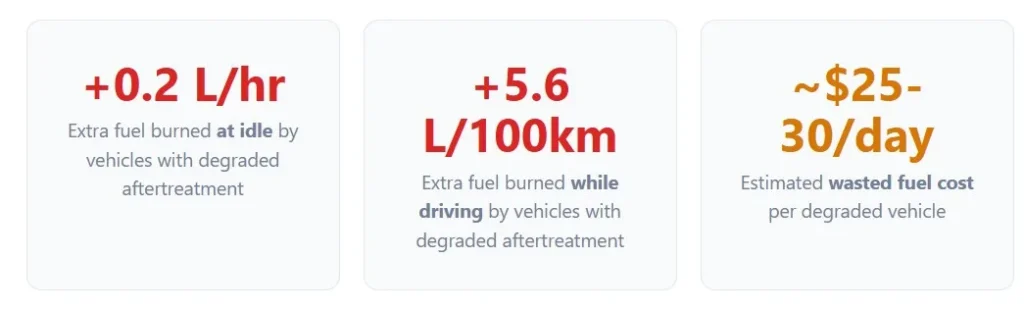
Vehicles with aftertreatment health scores below 40 (on a 0-100 scale) consistently burned more fuel than vehicles operating under identical conditions but with healthy aftertreatment systems.
For a truck driving 300 km per day, the driving fuel gap translates to approximately 17 extra liters of diesel daily. At current fuel prices, that’s roughly $25-30 per vehicle per day in avoidable cost. Across a fleet with even a dozen affected vehicles, the annual waste adds up to tens of thousands of dollars.
Why Aftertreatment?
The physics are straightforward. A clogged DPF increases exhaust back-pressure, forcing the engine to work harder to expel combustion gases. A degraded SCR system may trigger more frequent forced DPF regenerations, each of which involves injecting extra fuel into the exhaust stream to burn off accumulated soot. Both effects are continuous and proportional to the degree of degradation, which is why the linear relationship is so clear in the data.
Key Insight
The idle fuel gap is particularly telling. At idle, the engine is doing minimal work, so the operating-condition model has fewer variables to account for. Any excess fuel burn at idle is almost entirely attributable to mechanical factors. The fact that aftertreatment degradation shows up clearly even at idle confirms this is a real mechanical effect, not a statistical artifact of driving patterns.
· · ·
What This Means for Fleet Operations
The practical implications are direct.
First, aftertreatment maintenance has a measurable fuel ROI. Every day a vehicle operates with a degraded DPF or SCR system, it’s burning extra fuel. A DPF cleaning or SCR repair doesn’t just prevent a breakdown; it pays for itself through reduced fuel consumption. Fleet managers can now quantify that payback.
Second, the fuel gap is an early warning signal. A vehicle that starts consistently burning more fuel than its peers under similar conditions may be developing an aftertreatment issue before it triggers a DTC or a warning light. Monitoring the fuel gap adds a complementary detection layer to traditional diagnostic approaches.
Third, repair effectiveness can be validated. After an aftertreatment service, monitoring whether the fuel gap returns to zero provides a concrete, objective measure of whether the repair actually worked, beyond simply clearing a fault code.
The Bigger Picture
This analysis represents a broader shift in how fleet intelligence works. Rather than relying solely on fault codes and predefined thresholds, autonomous research agents can explore fleet data independently, discover non-obvious relationships, and quantify effects that would otherwise require significant time, effort, and resources to measure through traditional engineering methods.
The fuel-health connection is one example. The same methodology can be applied to tire wear patterns, brake system degradation, transmission efficiency loss, and other mechanical systems where degradation has an economic cost that’s hidden within normal operational variability.
The vehicles are already generating the data. The question is whether you’re extracting the intelligence from it.
From Insight to Action
Quantifying the problem is only the first step. What matters is catching it early and acting on it.
With Questar Total Fleet Health, aftertreatment degradation is identified at its earliest stages, long before it reaches the levels that drive the kind of fuel waste shown in this analysis. The platform continuously monitors every vehicle in your fleet, flags emerging aftertreatment issues, and provides clear, prioritized recommendations so your maintenance team knows exactly where to act and when.
The math is simple: catch a degrading aftertreatment system early, service it before it costs you $25-30 per day in wasted fuel, and the maintenance pays for itself many times over. That is how proactive fleet health management translates directly into lower fuel costs.